28 instruments and sounds of the symphony orchestra, each with a real recording you can play right here, how it makes its sound, and facts with sources.
Scientists sort instruments by what vibrates (the Hornbostel-Sachs system, 1914): strings, air, a stretched skin, or the whole instrument. Source
Strings
A string vibrates when it is bowed or plucked, and a hollow wooden body makes it louder.
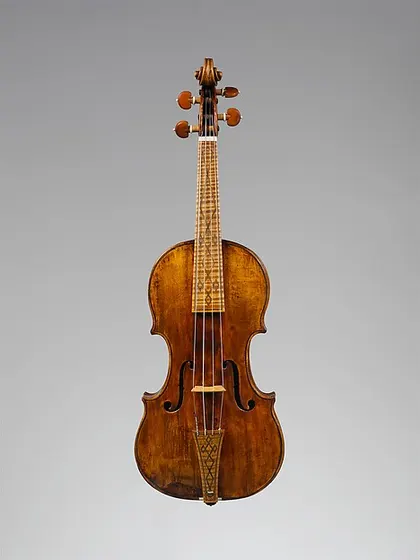
Violin
Chordophone: a stretched string vibrates
A bow strung with horsehair rubs the string, which sticks and slips many hundreds of times a second.
The violin is the smallest and highest member of its family. The viola, cello and double bass are its bigger relatives. Source
Its four strings are tuned in fifths: G, D, A and E. Source
Photo: Violin, Gift of Evelyn Stark, 1974. The Metropolitan Museum of Art, Open Access (CC0).
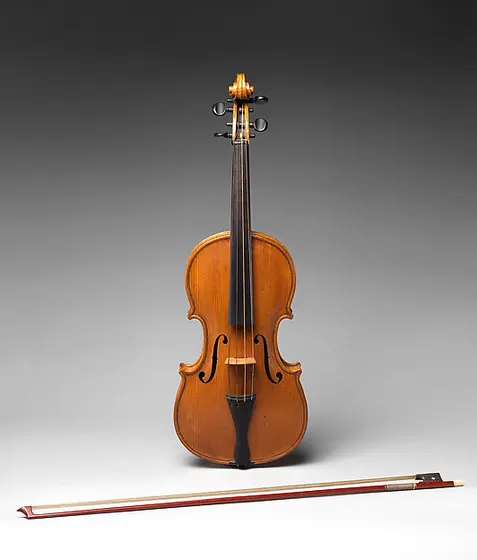
Viola
Chordophone: a stretched string vibrates
Bowed like the violin, but bigger, so it sounds lower and darker.
The viola is tuned a fifth below the violin: C, G, D and A. Source
Viola music is mostly written in the alto clef, which few other instruments use. Source
Photo: Viola, Gift of Mrs. H. M. S. Harris, 1906. The Metropolitan Museum of Art, Open Access (CC0).
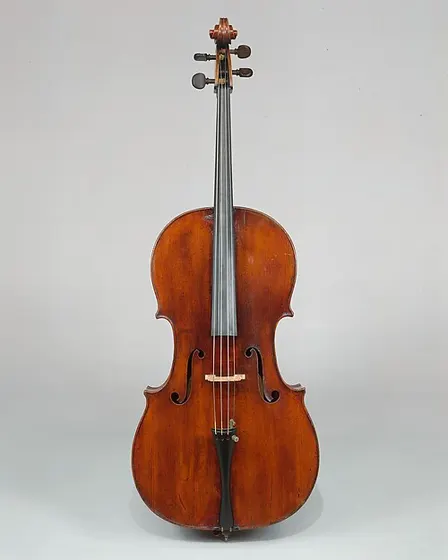
Cello
Chordophone: a stretched string vibrates
The player sits and bows it, with the instrument held between the knees and resting on a spike called the endpin.
The cello is tuned an octave below the viola: C, G, D and A. Source
Cello is short for violoncello, Italian for "little violone", an old large string instrument. Source
Photo: Violoncello, Gift of Dr. Peter Blos, 1984. The Metropolitan Museum of Art, Open Access (CC0).
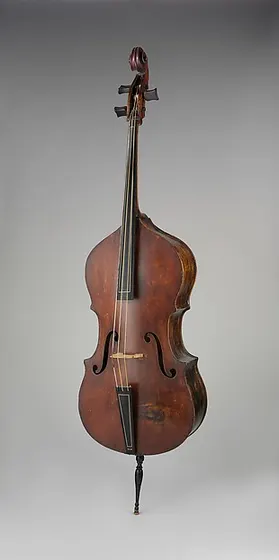
Double bass
Chordophone: a stretched string vibrates
The largest bowed string instrument of the orchestra. Players stand or sit on a tall stool.
Unlike the violin, viola and cello, the double bass is usually tuned in fourths: E, A, D and G. Source
Its music is written an octave higher than it sounds, so the notes fit on the staff. Source
Photo: Double Bass, Purchase, The Crosby Brown Collection of Musical Instruments, Gifts of Dr. and Mrs. Guido S. Corriero and Andrea Manley, by exchange, Rogers Fund, and funds from various donors, 1980. The Metropolitan Museum of Art, Open Access (CC0).
Pizzicato
Chordophone: a stretched string vibrates
Not an instrument but a way to play: the violinists pluck the strings with a finger instead of using the bow.
Pizzicato is Italian for "pinched" or "plucked". Source
Harp
Chordophone: a stretched string vibrates
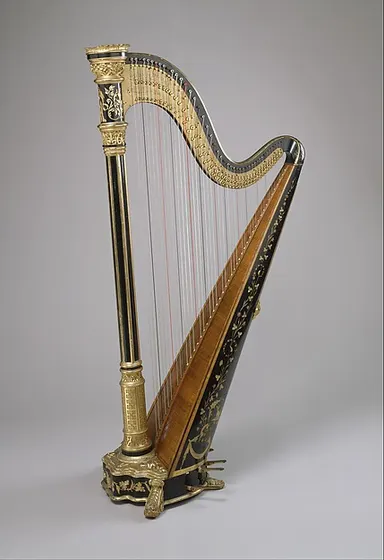
The strings are plucked with the fingers. Pedals at the base change their pitch.
A modern concert harp has 47 strings and seven pedals, one for each note name. Source
Harpists color the C strings red and the F strings dark blue or black, so they can find their place. Source
Photo: Pedal Harp, Purchase, Clara Mertens Bequest, in memory of André Mertens, 2001. The Metropolitan Museum of Art, Open Access (CC0).
Woodwinds
Air vibrates inside a tube. Covering holes makes the tube shorter or longer, and the note changes.
Piccolo
Aerophone: a column of air vibrates
A half-size flute. Air blown across the hole splits on its edge and sets the air inside ringing.
Piccolo is Italian for "small". It sounds an octave higher than its music is written. Source
It is the highest-pitched woodwind instrument of the orchestra. Source
Flute
Aerophone: a column of air vibrates
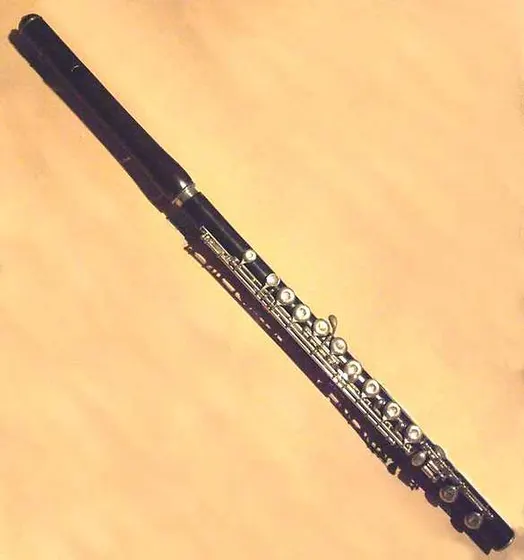
The player blows across a hole, not into a mouthpiece, so there is no reed. The air splits on the hole's edge.
Modern flutes are usually made of metal, but they are still woodwinds: the earliest concert flutes were wooden, and a woodwind can be made of any material. Source
Bone and ivory flutes found in caves in southern Germany are about 40,000 years old, the oldest instruments known. Source
Photo: Transverse Flute, Purchase, Mr. and Mrs. Thatcher M. Brown III and Eugene M. Grant Gifts, 1998. The Metropolitan Museum of Art, Open Access (CC0).
Oboe
Aerophone: a column of air vibrates
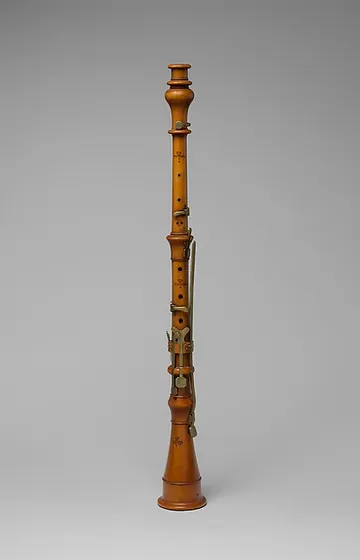
A double reed: two thin blades of cane tied together vibrate against each other as the player blows.
Before a concert the orchestra tunes to an A played by the oboe. Source
The name comes from the French hautbois, "high wood" or "loud wood". Source
Photo: Oboe, Museum Accession. The Metropolitan Museum of Art, Open Access (CC0).
Clarinet
Aerophone: a column of air vibrates
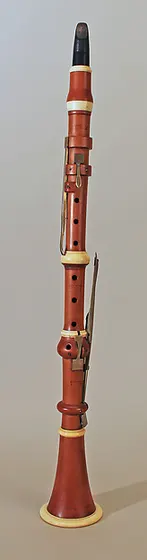
A single reed: one thin blade of cane is held against the mouthpiece and beats against it.
The common B-flat clarinet sounds a whole step lower than its music is written. Source
The clarinet was developed around 1700 from an older instrument, the chalumeau. Johann Christoph Denner of Nuremberg is generally credited with inventing it. Source
Photo: Clarinet, The Crosby Brown Collection of Musical Instruments, 1889. The Metropolitan Museum of Art, Open Access (CC0).
Bassoon
Aerophone: a column of air vibrates
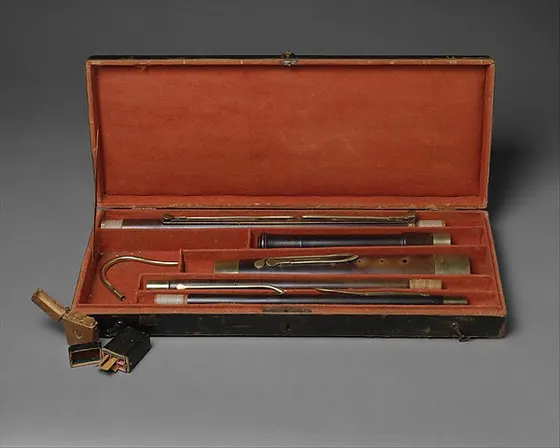
A double reed, like the oboe, on a long wooden tube folded back on itself.
Unfolded, the bassoon's tube would be about 2.5 meters (more than 8 feet) long. Source
The largest brass instrument, with a big mouthpiece and the widest tubing.
The tuba is the bass of the orchestra's brass section. Source
The tuba was invented in Prussia by Wilhelm Wieprecht and Johann Moritz and patented in 1835. Source
Percussion
Struck, shaken or scraped: drums, bars, bells, cymbals and more.
Timpani
Membranophone: a stretched skin vibrates
A skin stretched over a large copper bowl, struck with soft mallets. A pedal tightens the skin to raise the note.
Timpani, also called kettledrums, can be tuned quickly to exact notes with a foot pedal. Source
Snare drum
Membranophone: a stretched skin vibrates
Wires called snares are stretched across the bottom skin and rattle against it when the top is struck.
The snares give the drum its sharp, rattling sound. A lever called the strainer switches them on or off. Source
Bass drum
Membranophone: a stretched skin vibrates
The biggest drum of the orchestra, struck with a large soft beater.
The orchestral bass drum, gran cassa in Italian, is the largest drum of the orchestra. Source
Cymbals
Idiophone: the whole instrument vibrates
Two round plates of bronze are clashed together and left to ring.
The cymbal maker Zildjian was founded in Constantinople (today Istanbul) in 1623 and still makes cymbals. Source
Triangle
Idiophone: the whole instrument vibrates
A steel bar bent into a triangle with one corner left open, struck with a metal beater.
The triangle has no definite pitch. When struck it rings with many overtones at once. Source
Tam-tam (gong)
Idiophone: the whole instrument vibrates
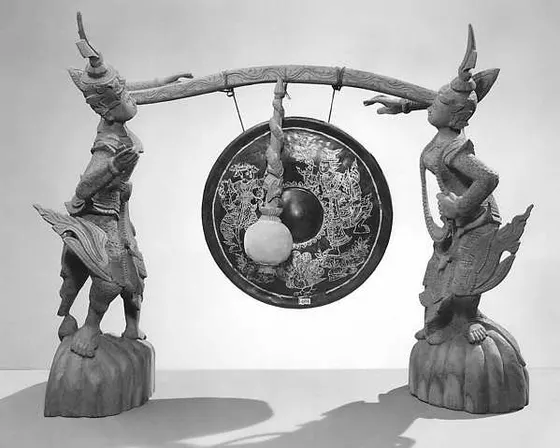
A large flat metal disc hung in a frame, struck with a soft beater. The sound swells after the stroke.
Orchestras call this gong a tam-tam because it has no definite pitch. Source
Photo: Gong, The Crosby Brown Collection of Musical Instruments, 1889. The Metropolitan Museum of Art, Open Access (CC0).
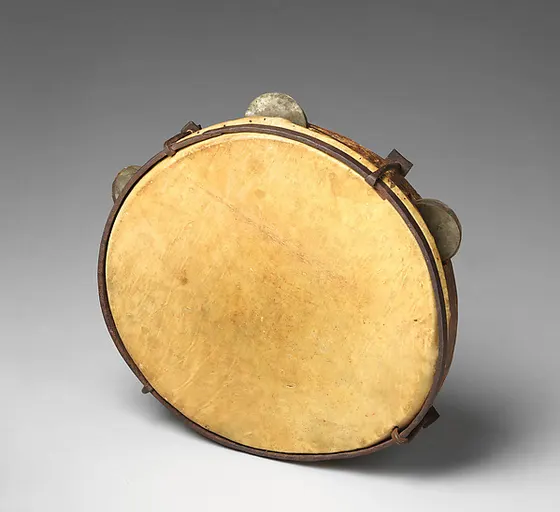
Tambourine
Membranophone: a stretched skin vibrates
A small frame drum with pairs of metal jingles set into the frame. It is shaken or struck.
The tambourine was played in ancient Egypt, the ancient Near East and later in Greece. Source
Photo: Tambourine, Gift of Peter Szego, 2024. The Metropolitan Museum of Art, Open Access (CC0).
Xylophone
Idiophone: the whole instrument vibrates
Hard wooden bars of different lengths are struck with mallets. Shorter bars play higher notes.
The name comes from the Greek xylon, "wood", and phone, "sound". Source
It sounds an octave higher than its music is written. Source
Marimba
Idiophone: the whole instrument vibrates
Wooden bars like a xylophone's, but each one has a tube under it that makes its note warmer and longer.
The marimba has roots in Africa and grew into its modern form in Central America, in Guatemala and Mexico. Source
Glockenspiel
Idiophone: the whole instrument vibrates
Steel bars laid out like a piano keyboard, struck with small hard mallets.
It sounds two octaves higher than its music is written. Source
Glockenspiel is German for "bell play": Glocke is bell, Spiel is play. Source
Tubular bells
Idiophone: the whole instrument vibrates
Long metal tubes hang in a frame and are struck near the top with a mallet. A pedal damps them.
Orchestras use tubular bells, also called chimes, when the music needs the sound of church bells. Source
Keyboards
Each key sets something else in motion: a hammer on a string, or wind into a pipe.
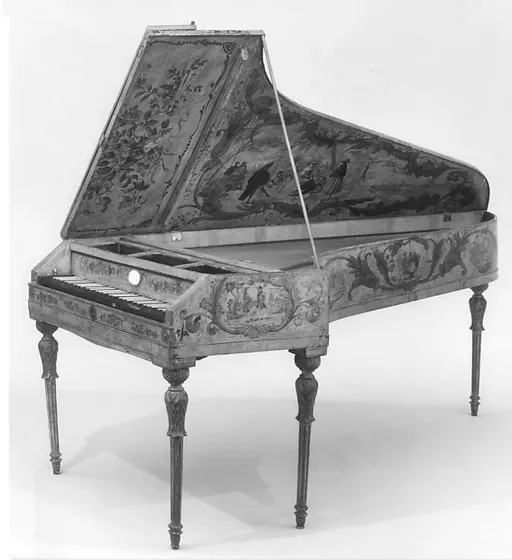
Piano
Chordophone: a stretched string vibrates
Each key throws a felt hammer against the strings. A damper stops them when the key is let go.
A standard modern piano has 88 keys, from A0 to C8. Source
Bartolomeo Cristofori built the first pianos in Florence around 1700. Source
Photo: Pianoforte, Gift of Mrs. Esme O'Brien Hammond, 1964. The Metropolitan Museum of Art, Open Access (CC0).
Pipe organ
Aerophone: a column of air vibrates
Each key lets wind into pipes. One pipe plays one note in one tone color, so large organs have thousands of pipes.
The organ is played with the hands on keyboards called manuals and with the feet on a pedalboard. Source
Recordings: Versilian Studios Chamber Orchestra 2, Community Edition (VSCO-2 CE), released under CC0 1.0. The pitch of each recording was measured, so the note names are the notes you hear.
Can you tell them apart with your eyes closed? Train it at the school in Hummingville, a minute a day.
 HUMMING